Research & Science
Research areas
Sleep connects biology, behavior, and the conditions of daily life. These four connected areas organize my work on what shapes sleep, how sleep contributes to health, and where intervention can make a difference.
Sleep in context: communities and health disparities
Understanding sleep means understanding the settings in which people live, and working with communities to identify useful opportunities for change.
The social-ecological model
Sleep takes place within a larger social and environmental context. The social-ecological model that I introduced with colleagues provides a way to organize that context: individual factors such as biology, beliefs, and behavior; social factors such as family, work, and neighborhood; and societal factors such as policy, technology, and culture.
This framework helps explain why knowing what to do is often not enough. An intervention may need to address a person’s habits, but it may also need to account for competing responsibilities, resources, or the sleep environment. The model has guided my work on sleep-health disparities and on interventions that reach beyond the individual.

Community partnerships
Sleep and health at the US–Mexico border
Our border-health research examines sleep within the social, cultural, and environmental conditions of the communities we work with. Through the Nogales Cardiometabolic Health and Sleep study (NOCHES), we have partnered with Mariposa Community Health Centers and promotoras de salud to understand sleep and its relationship to cardiovascular and metabolic health.
Community partnership is central to this work. It helps us ask relevant questions, understand local barriers and strengths, and develop approaches that fit the setting. NOCHES provides a foundation for studying how sleep may contribute to health disparities and where an intervention could be useful.
View the 2026 conference research →Duerme Mejor: building an intervention with the community
Duerme Mejor builds on this approach by developing a community-health-worker-delivered intervention that combines adapted cognitive behavioral therapy for insomnia (CBT-I) with strategies to extend sleep time. The NHLBI-funded project includes community input and a randomized trial designed to evaluate sleep and cardiometabolic outcomes.
The aim is to make effective sleep-health strategies more accessible and practical within existing community relationships. The trial will test the intervention; its benefits should not be assumed in advance.

Sleep, circadian rhythms, and cardiometabolic health
Sleep is a dimension of health, not simply the absence of a sleep disorder. This work examines its place in prevention, daily functioning, and cardiovascular and metabolic health.
Life’s Essential Sleep: sleep within Life’s Essential 8
Sleep belongs in the broader conversation about cardiovascular health. I helped develop the American Heart Association’s Life’s Essential 8 as an author of the presidential advisory that added sleep duration to the framework in 2022. Alongside nutrition, physical activity, nicotine exposure, and established clinical risk factors, sleep became part of how cardiovascular health is assessed.
This reflects a major shift in the field: sleep is increasingly being considered in prevention and health promotion, as well as in the treatment of sleep disorders. Our research asks how sleep contributes to health across the population and how that knowledge can inform care.

Beyond sleep duration
How much someone sleeps is only one part of the picture. Timing, regularity, continuity, quality, and daytime functioning provide different information about sleep health. As vice chair of the AHA’s 2025 scientific statement on multidimensional sleep health, I helped bring these dimensions together and examine their implications for cardiometabolic health.
Circadian rhythms are part of this same story. Sleep, light exposure, eating, and physical activity occur within biological timing systems. I also contributed to the AHA statement on circadian health, which considers how those patterns relate to cardiovascular health.

Cardiovascular resilience
A long-standing focus of my work is understanding how sleep relates to blood pressure, glucose regulation, and other aspects of cardiovascular and metabolic health. We need to understand both the biological pathways and the behaviors that make those pathways relevant in daily life. I contributed to the collaborative Nature Reviews Cardiology Roadmap on cardiovascular resilience, which connects sleep and circadian science with priorities for research and intervention.

Aggarwal B, et al. Nature Reviews Cardiology. 2026;23:116–130.
Read the Roadmap →Mental health and the waking mind at night
Different sleep problems may tell us different things about emotional vulnerability. We connect patterns in everyday life with experimental questions about timing, cognition, and behavior.
Emotional health
Sleep and mental health
Sleep and mental health are closely connected, but different sleep problems may carry different information. Insomnia, insufficient sleep, and nighttime wakefulness are not interchangeable. We study how these experiences relate to depression, emotional functioning, and suicide risk, and how they may help us understand vulnerability more clearly.
Our work spans community samples, college students and athletes, and large digital datasets. These studies allow us to examine both persistent sleep problems and daily patterns in mood and functioning. For example, our research on depression considers the experience of insomnia alongside sleep duration, rather than assuming that hours slept capture the whole problem.
More recent work examines how mood varies across the day and how those patterns relate to sleep. Together with our laboratory research, this helps connect everyday experience with questions about the timing and mechanisms of emotional vulnerability.
The goal is to identify useful targets for intervention. Observational findings guide that work, while clinical and experimental studies are needed to establish whether changing sleep improves a particular mental-health outcome.

Nighttime cognition
The Mind After Midnight
We think, feel, and make decisions differently across the day and night. The Mind After Midnight hypothesis asks whether being awake during the biological night creates a particular combination of changes in emotion, reward processing, and cognitive control that can increase vulnerability to harmful behavior.
I developed this framework with colleagues and now lead a five-year, $3.8 million NIMH-funded project with Fabian-Xosé Fernandez to test its proposed mechanisms. We combine measurement at home with laboratory assessments of brain function, emotion, and decision-making, including comparisons between staying awake and waking from sleep.

A proposed model of the waking mind at night
The model brings together circadian timing, the pressure to sleep that builds while we are awake, and the grogginess that can follow awakening. It proposes that nighttime wakefulness may make negative thoughts more difficult to regulate, alter how rewards are evaluated, and reduce the cognitive control needed to step back from an immediate reaction.
These processes also occur within a person’s circumstances. Stress, insomnia, nightmares, substance use, and access to support may influence what happens during the night. The research question is how these factors interact, and whether understanding them can help identify opportunities for prevention.
This remains a proposed framework. We need experiments that distinguish the effects of the biological night from sleep loss and from the circumstances that keep someone awake. “Midnight” refers to a biological period, not a single clock time that applies to everyone.

Adapted and redrawn from Figure 2 (central panel), Tubbs et al. (2022), CC BY 4.0; original figure adapted from Perlis et al. (2016b). Peripheral pathways omitted. Proposed mechanisms, not established causal effects. View full-size figure.
PFC: prefrontal cortex; dACC: dorsal anterior cingulate cortex; rACC: rostral anterior cingulate cortex; NAcc: nucleus accumbens; AI: anterior insula; AMY: amygdala.
Read The Mind After Midnight framework →
Read the University of Arizona project account →Measurement, technology, and intervention
Better tools should help us answer better questions and make better decisions. Our work connects measurement performance with individualized guidance and approaches to light exposure.
Wearable measurement
Measuring sleep outside the laboratory
Wearables make it possible to study sleep over time, in the settings where people actually live. They also raise basic measurement questions. What does a device capture accurately? How much do the results depend on the algorithm, the person, or the setting?
My work includes evaluating wearable measurements against laboratory and home reference methods. Our smart-ring study examined both generalized and personalized algorithms. This helps establish what a particular tool can contribute to research and practice, and where its limitations matter.
Read the smart-ring validation study →Personalized guidance
Hypknowledge
Hypknowledge addresses a practical problem: people may want to improve their sleep without knowing which change is most likely to help them. The platform combines tracking with individualized guidance, using information over time to refine the approach.
Developed with Michael Perlis, this work connects behavioral sleep science with scalable technology. Our focus is on developing and testing an approach to sleep optimization, rather than assuming that collecting more data by itself leads to better sleep.
University recognition: Tech Launch Arizona announcement.
Light and circadian technology
Light is an important input to the circadian system. With colleagues in neuroscience and optical sciences, I have studied the spectral properties of eyewear and contributed to inventions that selectively filter or transmit light. This work connects the physical properties of a product with questions about its biological effects.

Research methods
Studying sleep from daily life to the laboratory.
Population research
Population datasets help us examine sleep across different groups and settings, identify disparities, and study associations with health and functioning. Wearable datasets add a view of how sleep changes over time. Our analysis of Fitbit data during the pandemic is one example. Read the study.
Sleep in daily life
Diaries, actigraphy, home monitoring, and interviews connect sleep measurements with people’s routines and experiences. Combining these approaches helps us understand differences between reported sleep, measured sleep, and daytime functioning.
Laboratory and physiological assessment
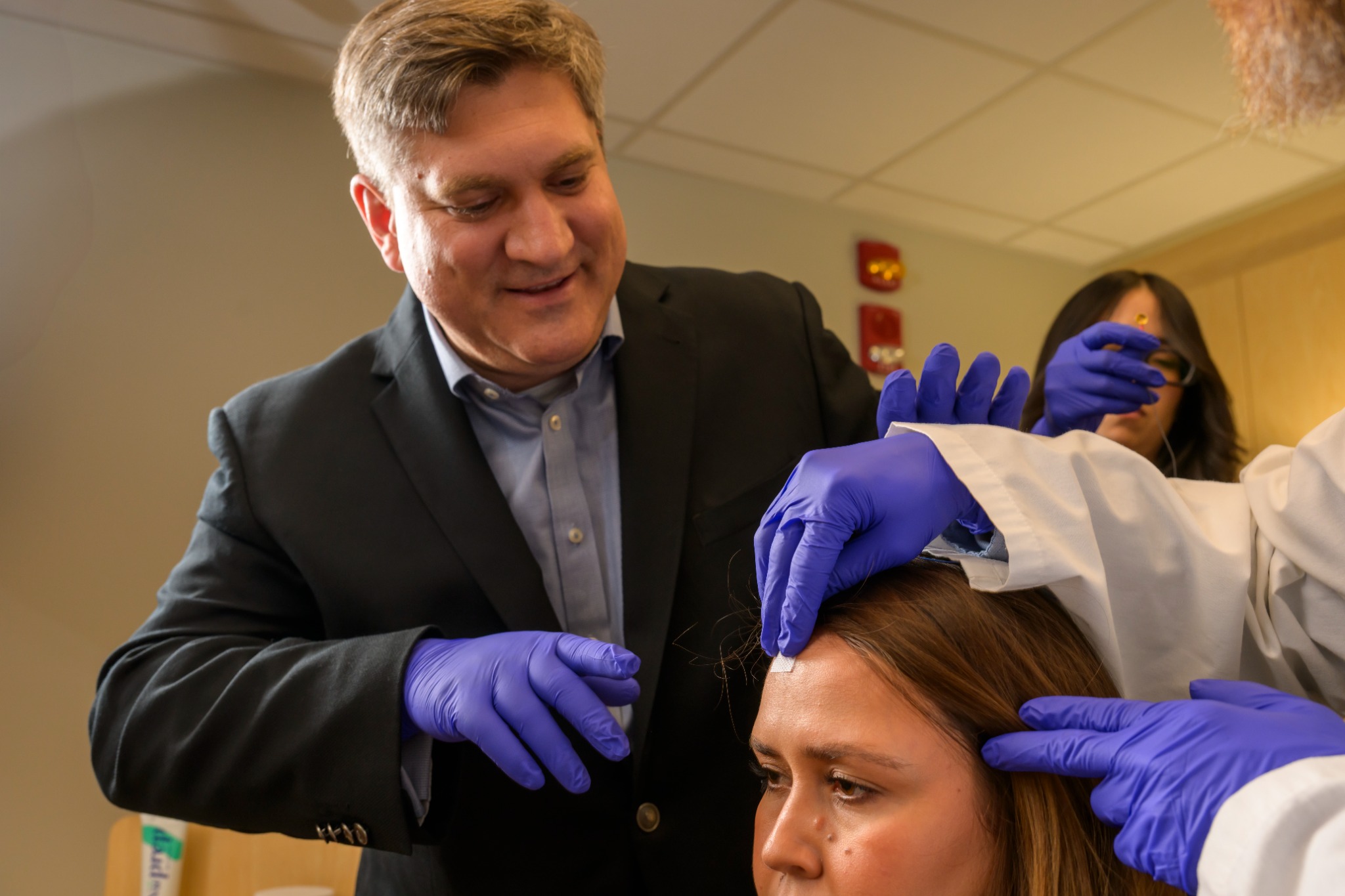
Laboratory studies allow us to examine physiological and behavioral processes in greater detail. Depending on the question, we use sleep recordings, cardiovascular and metabolic assessments, and tests of attention, cognition, and emotion.
Environment and intervention
Intervention studies test whether an approach changes sleep and whether those changes matter for health or functioning. Community partnerships and program evaluation help us understand how an approach can work outside a controlled research setting.
Project portfolio
Additional studies and lines of inquiry.
These projects reflect connected lines of work across sleep behavior, health, performance, and the conditions that shape them. The index includes both current and historical projects.
Community, family, and population health
- Platicamos Sueño
- Sleep education developed with community health workers.
- DABITS
- Intergenerational stress, sleep, and border-community health.
- Hawaiian Islands Sleep and Health Study
- Social stress and cardiometabolic sleep-health questions on Oahu.
- FAMILISMO
- Family-centered sleep and nutrition intervention development.
- SHADES
- Social, environmental, and behavioral determinants of sleep.
- Sleep and Health in Society
- Population patterns and disparities using large datasets.
Behavioral interventions, performance, and measurement
- WISH
- Sleep-health promotion within smoking cessation for adults with HIV.
- Project REST
- Flexible sleep-health promotion for college students.
- PHOTONS
- Evaluation of a phototherapy-based sleep device.
- MODEST
- How people interpret sleepiness and consider seeking care.
- CHARTS
- Habitual short sleep and cardiometabolic functioning.
Nighttime cognition, mental health, and dreams
- ANSWERS
- Sleep–wake patterns and suicide-related risk.
- IN-BeD
- Time-of-day differences in cognition, emotion, and decisions.
- COVID dream study
- Pandemic experiences and changes in dreaming.
Contact the team for current study status or participation information.
Follow the questions and the evidence.
For study participation, contact the team about current opportunities. Please keep personal health information out of an initial inquiry.