
Learn · Student Training Programs
Student training in sleep and circadian science.
Develop research skills, explore clinical questions, and learn how sleep connects with health through mentored training in the Sleep and Health Research Program.
Explore the training options below, then contact the program and your home department about current openings, eligibility, supervision, funding, and academic requirements.
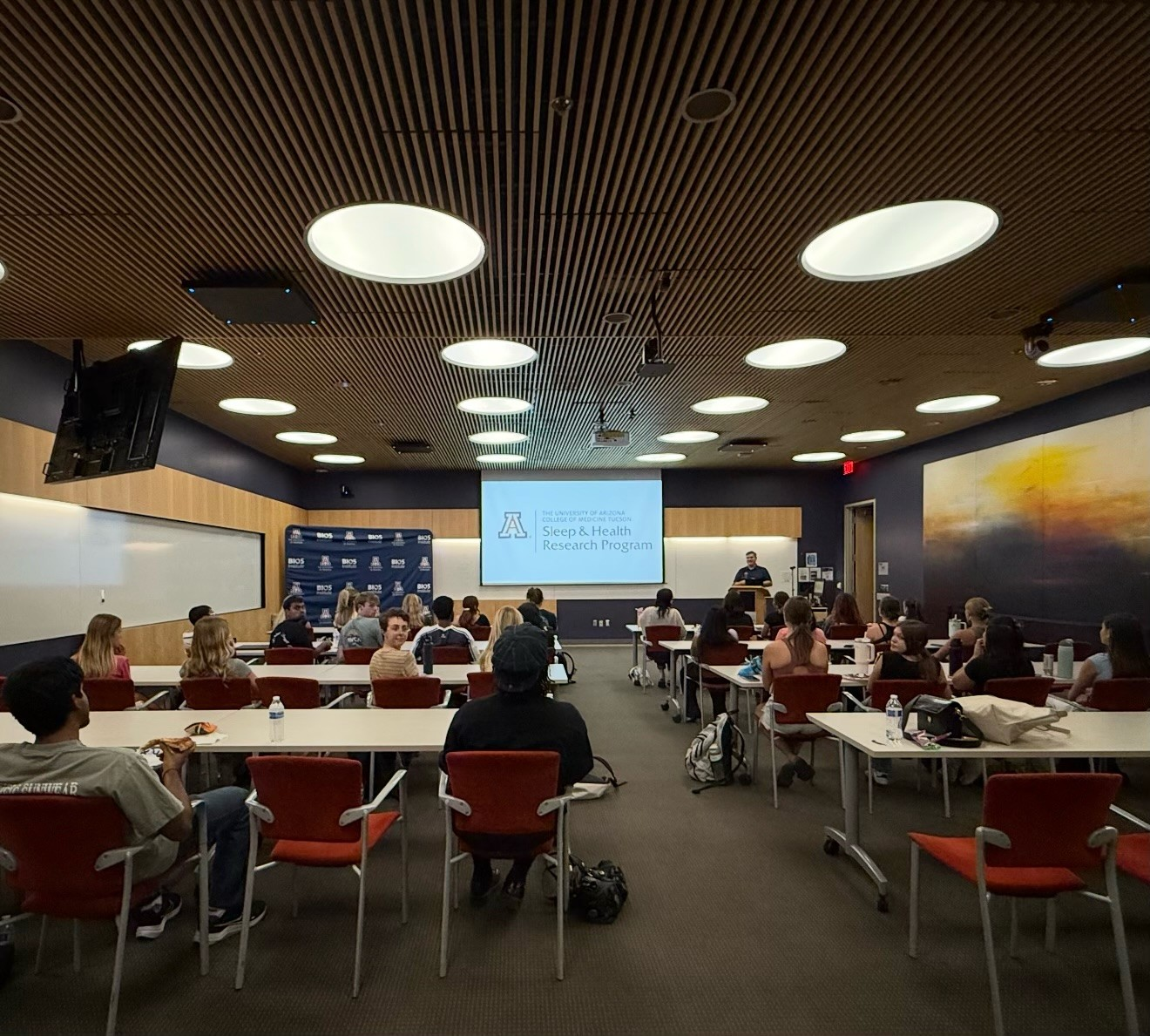
01 · Undergraduate students
Undergraduate students: research training.
Research assistantship
This competitive placement typically involves a year-long commitment, with hands-on research experience and a smaller project. Students learn about sleep and circadian science while contributing to ongoing work. A project may take the form of a paper, presentation, or another agreed product.
Independent research project
This intensive, two-semester pathway supports students developing an independent project, potentially as an honors or senior thesis. The work can span a literature review, research question, data collection or processing, analysis, writing, and presentation. Conference abstracts and manuscripts are goals of the process, not guaranteed outcomes.
Fall semester
Choose a topic, prepare a brief literature review, assist with data collection and processing, and develop a research abstract for a scientific conference.
Spring semester
Develop a full research paper, building the introduction from the literature review and the methods and results from the abstract. Prepare a poster or talk and present the work to the group. The goals include a first-author manuscript ready for submission and a conference presentation. Mentored journal-article reviews build critical reading skills. Honors credit can be arranged with the appropriate academic approval.
Next step: discuss fit
Describe your year, major, research interests, and availability. Say whether you are seeking a research assistantship or an independent thesis project, and identify any credit or advisor requirements. Ask about current placements and the application process before submitting materials.
02 · Graduate / Medical students
Graduate and medical student pathways.
PhD students
Doctoral students build broad expertise in sleep and circadian science and deep expertise in the question that becomes their dissertation. Training covers the full research process: identifying a consequential question, forming testable hypotheses, designing studies, and turning results into publishable work.
What you will work on
- Survey, observational, clinical-trial, or systems-level study design appropriate to the research question.
- Regulatory oversight, recruitment, screening, consent, assessments, interventions, and database management.
- Statistical analysis plans, empirical manuscripts, protocol papers, reviews, and the publication process.
- Grant writing, professional-society participation, conference presentations, and a one-hour research lecture with questions.
Degree pathways
Routes include Physiological Sciences, Neuroscience, and Clinical Translational Sciences. Mentoring has also extended to School Psychology and MD/PhD students. A Clinical Psychology route may require special arrangements.
Next step: apply through the program
Contact Michael early to discuss the research fit and whether he can take a student through your intended program. Apply through that degree program’s formal admissions process. Admission depends on program capacity, faculty availability, and funding, not research fit alone. The university program pages provide current admissions requirements; contacting the lab does not replace an application.
Master’s students
Master’s training centers on a focused thesis question in sleep and circadian science. Students develop the literature background, translate a question into a practical study, contribute to research operations, and carry out elements of the analysis.
What you will work on
- Developing a thesis topic and testable hypotheses.
- Study activities such as recruitment, assessments, data management, or regulatory work, matched to the project.
- Data analysis and a manuscript intended for submission as an empirical paper.
- Contributions to reviews or other manuscripts, research presentations, and a one-hour presentation of your work.
Master’s mentoring pathways include Physiological Sciences and Clinical Translational Sciences. The lab does not guarantee a stipend or tuition support for a master’s placement. Physiological Sciences separately advertises opportunities for funding through teaching assistantships; availability and eligibility must be confirmed with the degree program.
Next step: apply through the program
Discuss your thesis interests and mentoring fit with Michael, then follow the chosen master’s program’s admissions process. Clarify tuition, time commitments, assistantship options, and project resources before accepting a placement.
Medical students
University of Arizona College of Medicine students can undertake research alongside their medical training. Projects range from contributions to an ongoing study to a student-led project. The scope is matched to the student’s interests, experience, and available time.
A typical arrangement identifies work that the student can complete flexibly, with periodic meetings with Michael. Research abstracts, presentations, and manuscripts are possible products; authorship and publication depend on the actual contribution and completed work, not simply participation.
Next step: inquire
Contact Michael with your medical-school year, research interests, experience, and available time. Indicate whether you need a short project or a longer research experience and whether it must meet a school requirement. Agree on the project, supervision, and milestones before beginning.
Clinical psychology externship
The Behavioral Sleep Medicine Clinic provides an externship for University of Arizona clinical psychology graduate students. Its educational focus includes assessment instruments, clinical interviewing, case formulation, documentation, supervised clinical work, and participation in the Seminar. Clinical training covers insomnia, circadian rhythm problems, and behavioral aspects of other sleep disorders, with attention to medical and psychiatric context. Training includes CBT-I and other nonmedication approaches, such as sleep compression, circadian interventions, and support for sleep-apnea treatment adherence.
Weekly training structure
The established externship structure is approximately 10 hours per week: six hours of patient contact, two hours of preparation and documentation, one hour of supervision, and one hour in the Behavioral Sleep Medicine Seminar. Patient work progresses through observation, directly supervised sessions, and recorded sessions reviewed in supervision. A supervised reading list complements clinical work.
Next step: inquire
University of Arizona clinical psychology graduate students should contact Michael directly and coordinate with their training program. Confirm the current schedule, supervisor, and academic approvals before arranging the rotation.
Next step: discuss fit
For a first conversation, identify the pathway above and your intended degree program. Degree admission and a lab placement are separate decisions.
03 · Interns / Residents / Fellows
Interns, residents, and fellows: clinical training.
Psychology internship rotation
Behavioral Sleep Medicine is a clinical rotation within the University of Arizona doctoral psychology internship. Interns learn sleep-disorder screening, assessment, diagnosis, and treatment, including clinical interviewing, test scoring, case formulation, and attention to co-occurring medical and psychiatric conditions.
Sleep health research rotation
A separate research rotation offers one day per week in the Sleep and Health Research Program. It combines readings, weekly meetings with Michael, manuscript and grant preparation, and planning for a research-focused postdoc. Prior related research experience is helpful.
Next step: apply through the program
Apply to the university internship through its APPIC process, not a lab inquiry email. Required materials include a track-specific cover letter, graduate transcripts, three standardized references, and a CV. Current interns should discuss rotation selection with program leadership and Michael.
Internship eligibility, application instructions, and current deadlines →
Psychiatry residency elective
Fourth-year University of Arizona psychiatry residents can pursue an elective in behavioral sleep medicine. Its educational elements include clinical observation, supervised cases, didactic sessions, and reading, with a particular emphasis on CBT-I. The rotation combines patient interviews, assessment and follow-up, preparation of clinical notes, individual supervision, group didactics, and assigned readings. Training has been offered over periods from eight weeks to a year.
Contact Michael and the psychiatry residency to discuss timing and approval. Agree on the current weekly workload with the residency and clinic before scheduling the elective.
Sleep medicine fellowship rotation
The Behavioral Sleep Medicine Clinic contributes behavioral insomnia treatment training to the University of Arizona Department of Medicine’s Sleep Medicine fellowship. Prospective fellows should use the Department of Medicine Sleep Medicine fellowship page for its admissions requirements and clinical rotations.
This rotation within a medical Sleep Medicine fellowship is distinct from the separate Fellowship in Behavioral Sleep Medicine page.
Next step: discuss fit
Identify your residency or fellowship, training year, and proposed rotation period. Ask about supervision and current rotation arrangements, and coordinate approval with your home program. Inquiries about the medical Sleep Medicine fellowship should follow that program’s admissions process.
04 · Postdocs
Postdocs: research and career development.
Postdoctoral research opportunities depend on available funding and the needs of specific projects. Postdocs typically join through a named position on an existing research grant; the funding mechanism determines the position’s scope, rather than a standing promise of an open postdoctoral position.
Additional mentoring routes have included interdisciplinary training in cardiovascular research, diabetes and metabolism, neurobiology of aging and Alzheimer’s disease, and physician-scientist development. Applicants interested in these routes should first ask the relevant training program about eligibility and available positions, then discuss a mentoring match with Michael. These program routes are distinct from a grant-funded opening in the lab.
Next step: discuss fit
Describe your research direction, methods, experience, and desired mentoring. Ask whether a relevant funded position or training mechanism is available and how to apply. Confirm eligibility, appointment terms, and funding before making plans.
05 · BSM Fellowship
Fellowship in Behavioral Sleep Medicine.
Behavioral sleep medicine focuses on behavioral, psychological, and contextual approaches to sleep problems. This fellowship pathway is presented separately from student research placements, psychiatry electives, and rotations within a medical Sleep Medicine fellowship.
Explore the Fellowship in Behavioral Sleep Medicine to learn about the training approach. Contact Michael to confirm current curriculum, supervision, eligibility, timing, funding, and application details. An open position or application cycle is not currently announced.
Learn more and inquire
Review the fellowship page, then email Michael to ask about current plans and the appropriate next step. Identify your training background and the aspects of behavioral sleep medicine you hope to develop. An inquiry is not an application.
Prepare your inquiry
Make your interests and constraints clear.
Applying to the lab: The former online lab application form is not currently active. Email Michael to ask about a placement and the appropriate application route. Degree-program applications and clinical rotation approvals still follow their own institutional processes.
- Your background: current program, career stage, and relevant experience.
- Your interests: sleep-related questions and skills you hope to develop.
- Your availability: proposed start date and realistic time commitment.
- Academic requirements: degree, thesis, practicum, rotation, or credit requirements.
Consider what you want to learn as well as what you hope to produce. Learning to formulate a question, document a method, interpret an uncertain result, or revise a manuscript can be as important as the final poster or paper. Discuss expectations for feedback, meetings, project ownership, and completion with the prospective mentor.
Before committing, clarify who approves the placement, whether it carries credit, what training and supervision are required, and whether any funding is available. Do not assume that a listed pathway means an opening is currently available.
Other learning pathways
Keep exploring.
Professional workshops, CBT-I certification information, and the Behavioral Sleep Medicine fellowship are distinct from student placements. The Seminar offers a separate place to follow discussion across the field.